How AI Predicts Customer Churn Before It Happens (2026 Guide)

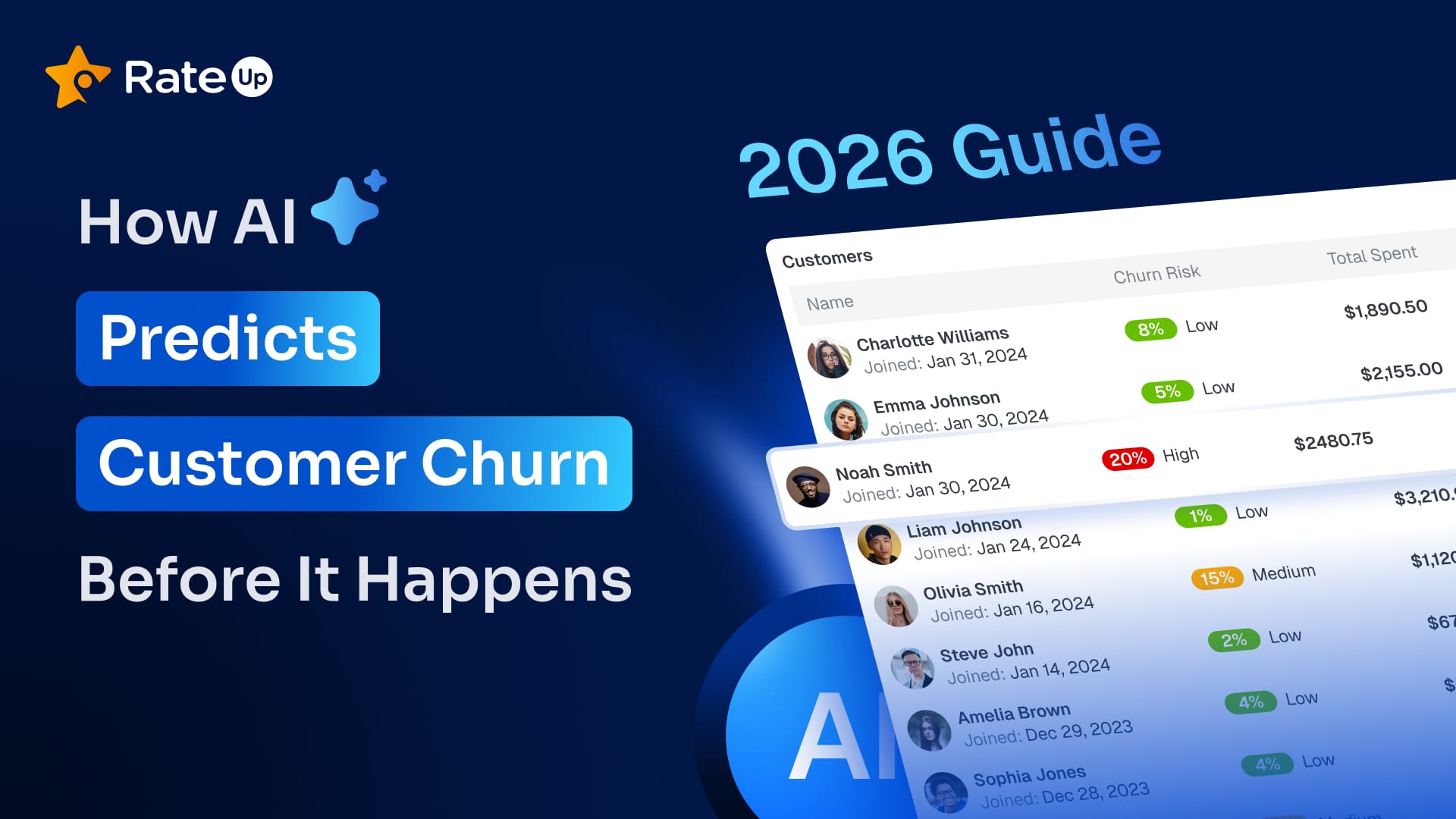
AI predicts customer churn by continuously analysing behavioural signals — purchase frequency trends, communication engagement drops, feedback score changes, browsing patterns, and support interaction spikes — to calculate a real-time churn probability score for each customer. When a score crosses a defined threshold, an automated intervention triggers (a personal WhatsApp message, a loyalty reward, a support check-in) before the customer has consciously decided to leave. Research shows that 85% of churn is preventable, and AI-powered early intervention achieves 60–70% retention success when applied at the first warning signal.
The traditional approach to customer churn is reactive: a customer stops buying, you notice eventually, you launch a win-back campaign, you recover maybe 10–15% of them. The rest are gone.
AI churn prediction flips this entirely. Instead of responding to churn that's already happened, you predict which customers are about to churn — 30, 60, even 90 days before they make the decision — and intervene when the relationship is still salvageable.
This guide explains exactly how AI churn prediction works, what data it uses, how accurate it is, and how ecommerce brands are using it in practice.
Why Reactive Churn Management Fails
Most ecommerce brands discover churn too late. By the time a customer shows up in a "lapsed buyers" segment — typically defined as "no purchase in 90 days" — they've already been disengaging for months.
The typical churn trajectory looks like this:
- Customer has a mildly negative experience (slow delivery, product not as expected)
- They don't complain — they just feel slightly less positive
- Their next purchase is slightly delayed
- They open fewer emails
- They abandon a cart without recovering
- 90 days pass — they've now officially "churned" in your analytics
- You send a win-back email with 10% off
- They don't respond
By step 7, you're 4–5 months into the disengagement arc. The relationship damage is significant, and the win-back conversion rate reflects it. Step 1 was the intervention window — and you missed it because you had no system to detect it.
What Data AI Churn Prediction Models Use
Effective churn prediction models analyse signals across multiple data dimensions simultaneously:
Purchase Behaviour Signals
- Recency — how long since their last purchase
- Frequency trend — is their purchase rate accelerating, stable, or declining?
- Order value trend — are they spending more or less per order over time?
- Category drift — are they buying from fewer categories than before?
- Repurchase interval — how does their current gap compare to their personal average?
Engagement Signals
- Email open rate trend — declining opens over the last 60 days
- WhatsApp response rate — not responding to messages they previously engaged with
- Website session frequency — visiting less often
- Browse-to-cart rate — adding items to cart less frequently relative to sessions
Sentiment Signals
- NPS score trend — scored lower on last survey than previous surveys
- Feedback score — recent 1–3 star response
- Support contact volume — sudden spike in support contacts
- Complaint topics — specific issue types that historically predict churn (e.g. delivery problems)
Transactional Risk Signals
- Failed payment attempts — card declined, payment not completed
- Return rate increase — returning more than usual
- Discount dependency — only purchasing when a promotion is active
- Cart abandonment frequency — abandoning carts without converting
AI churn models don't look at these signals in isolation — they analyse the combination and sequence of signals, which is far more predictive than any single indicator alone. A customer with a declining open rate and a longer-than-usual purchase gap and a lower NPS score is exponentially more at risk than a customer with just one of those signals.
How the AI Calculates a Churn Risk Score
The churn prediction model outputs a churn risk score — a number (typically 0–100) representing the probability that this customer will not make another purchase within their expected repurchase window.
Score ranges and what they mean:
| Risk Score | Churn Probability | Recommended Action |
|---|---|---|
| 0–30 | Low | Standard engagement — no intervention needed |
| 31–55 | Moderate | Proactive loyalty reward or personalised recommendation |
| 56–75 | High | Personal WhatsApp check-in from team member |
| 76–90 | Critical | Senior team intervention + recovery offer |
| 91–100 | Near-certain | Last-chance win-back attempt |
The model recalculates scores continuously — as new purchases, engagement events, and customer feedback responses come in, every customer's score updates in real time. A customer who was at risk and just made a purchase will see their score drop automatically.
The Intervention Playbook: What to Do at Each Risk Level
Knowing a customer is at risk is only valuable if you act on it. Here's the intervention logic that converts churn prediction into retention:
Moderate Risk (31–55): Proactive Value
Who: Customers showing early signs of disengagement — slightly lower engagement, slightly longer purchase gap than usual.
Intervention: Send a personalised product recommendation or loyalty reward via WhatsApp. No mention of retention. Just genuine value: "Hi [Name], we thought you'd love our new [category] — based on your last order, this feels like your kind of thing." The goal is to re-engage with relevance, not alarm them with a "we noticed you haven't bought" message.
Success rate: 50–65% re-engagement
High Risk (56–75): Personal Outreach
Who: Customers with multiple concurrent warning signals — communication disengagement, purchase gap, and declining sentiment.
Intervention: A personal WhatsApp message from a named team member: "Hi [Name], I wanted to personally check in — is there anything we could be doing better for you?" No promotional intent. Just genuine curiosity and care.
Success rate: 30–45% re-engagement
Critical Risk (76–90): Senior Escalation
Who: Customers with a negative feedback response that was unresolved, or customers who are clearly in an active disengagement phase.
Intervention: Senior team member or founder outreach — via WhatsApp with a meaningful resolution offer. This is the moment to fix the specific thing that's broken, not offer a generic discount.
Success rate: 15–30% re-engagement
Near-Certain Churn (91–100): Last Attempt
Who: Customers who've stopped engaging with all outreach, have a long purchase gap, and show no positive signals.
Intervention: A final personal message with a genuine, high-value incentive. Plain text, no design. From the founder. "I'd love to understand what went wrong. If you're open to it, here's [meaningful offer] as a genuine apology."
Success rate: 8–15% re-engagement
How Accurate Is AI Churn Prediction?
Accuracy depends on the quality and volume of data available. Here's what well-implemented churn prediction models typically achieve:
| Metric | Typical Performance |
|---|---|
| Prediction accuracy | 75–90% (correctly identifying who will churn) |
| False positive rate | 15–25% (flagging customers who wouldn't have churned) |
| Lead time | 30–90 days before actual churn |
| Retention improvement | 20–35% reduction in churn rate vs reactive approach |
The false positive rate matters less than it sounds. A "false positive" — a customer flagged as at risk who wouldn't have churned — just receives a proactive, personalised outreach message. Even if they weren't about to leave, a genuine check-in strengthens the relationship. There's no downside to reaching out to a customer who's actually fine.
AI Churn Prediction in Practice: A Real Scenario
Here's how AI churn prediction plays out for a typical D2C ecommerce brand:
The customer: A buyer who purchased 5 times over 18 months, always rating 4–5 stars, with a 45-day average repurchase interval.
Week 8 (after last purchase): Still within expected range. Churn risk score: 22.
Week 10: No purchase yet (slightly past average interval). Email open rate has dropped. Churn risk score: 38. → System flags as Moderate Risk. Automated WhatsApp with personalised recommendation sent. Customer opens but doesn't respond.
Week 12: Still no purchase. No WhatsApp response. The customer's last feedback score was 4 stars, but they'd previously scored 5. Churn risk score: 64. → System escalates to High Risk. Personal message from team member: "Hi [Name], I just wanted to check in — everything okay with your last order?" Customer responds: "The delivery took longer than expected." Team resolves. Score drops to 29.
Week 13: Customer makes a purchase. Churn risk score: 15.
Without AI churn prediction, this customer's drift would have continued undetected until they hit 90 days lapsed and appeared in a "lapsed buyers" segment — by which point the relationship damage would have been much harder to repair.
RateUp's AI Churn Prediction: What's Coming
RateUp currently tags customers automatically as At Risk based on a combination of engagement and purchase signals. The upcoming AI Scoring feature will extend this with:
- Real-time churn probability scores for every customer
- Automated intervention triggers at each risk threshold
- Predictive LTV — projected lifetime value to help prioritise which at-risk customers are worth the most to recover
- Campaign timing optimiser — AI-recommended send times for re-engagement messages based on each customer's individual engagement patterns
→ Join the waitlist for AI Scoring
Frequently Asked Questions
What is AI churn prediction?
AI churn prediction is the use of machine learning models to calculate the probability that each customer will stop purchasing within a defined future period — typically 30, 60, or 90 days. The model analyses patterns across purchase behaviour, engagement data, feedback scores, and support interactions to produce a churn risk score for every customer. When a score crosses a defined threshold, automated or human intervention is triggered to prevent the churn before it happens.
How accurate is AI churn prediction for ecommerce?
Well-implemented AI churn prediction models achieve 75–90% accuracy in identifying customers who will churn, with a 30–90 day lead time before actual churn occurs. The accuracy improves with more historical data — models with 12+ months of customer behaviour data significantly outperform those trained on shorter timeframes. Even at 80% accuracy, catching 8 out of 10 at-risk customers before they leave — compared to catching 0 with a reactive approach — delivers a major retention improvement.
What is the difference between churn prediction and churn analysis?
Churn analysis looks backwards — it examines customers who have already churned to identify patterns and root causes. Churn prediction looks forwards — it uses current behavioural data to identify which active customers are likely to churn before they do. Both are valuable: churn analysis tells you why customers leave so you can fix root causes; churn prediction tells you who is about to leave so you can intervene. The most effective retention programmes use both.
How much data does AI churn prediction need to work effectively?
AI churn prediction models become meaningfully accurate with a minimum of 3–6 months of customer behavioural data and at least several hundred customer records. More data produces more accurate predictions. For early-stage brands with limited historical data, rule-based churn risk scoring (flagging customers based on explicit behavioural thresholds) is more appropriate than ML-based prediction until sufficient data accumulates.
Can small ecommerce brands use AI churn prediction?
Yes, but the approach should be scaled to the business. For brands with fewer than 1,000 active customers, rule-based At Risk tagging (based on purchase recency, engagement, and feedback signals) achieves most of the practical benefit of full ML-based churn prediction with much lower data requirements. As customer volume grows, transitioning to a full predictive model becomes more valuable. RateUp's current At Risk tagging works for brands of any size; the upcoming AI Scoring feature will deliver full predictive scoring at any volume.
How do I act on AI churn predictions without annoying customers?
The key is matching intervention intensity to risk level — don't send an aggressive win-back campaign to a customer with a moderate churn risk score. Moderate risk warrants a genuinely helpful, value-add message (a personalised recommendation, a relevant tip, a loyalty reward notification). High risk warrants a personal check-in without promotional intent. Critical risk warrants a direct acknowledgment that something may be wrong and a genuine offer to help. The framing should always feel like care, not desperation. Customers respond to brands that notice and care about their experience — not brands that notice they haven't spent money recently.
What is the ROI of AI churn prediction for ecommerce?
The ROI depends on your customer LTV and intervention success rate. A simplified example: if your average customer LTV is $200, you have 500 at-risk customers flagged by AI, and your intervention converts 35% (175 customers) — that's $35,000 in retained revenue from a single retention campaign. Against a platform cost of $100–$300/month, the ROI is substantial even at modest intervention success rates. The ROI improves further when you consider that retained customers also refer others and tend to increase their spend over time.
Does AI churn prediction work for subscription ecommerce?
Yes — and it's actually more straightforward for subscriptions because churn is explicit (cancellation) rather than implicit (not repurchasing). For subscription ecommerce, AI churn prediction analyses signals like failed payments, paused subscriptions, support contacts about cancellation, engagement drops with subscription-related emails, and reduced consumption rate. Early intervention before a cancellation decision is made is particularly high-value in subscriptions because the recurring revenue impact of each retained subscriber is compounded over their remaining subscription lifetime.